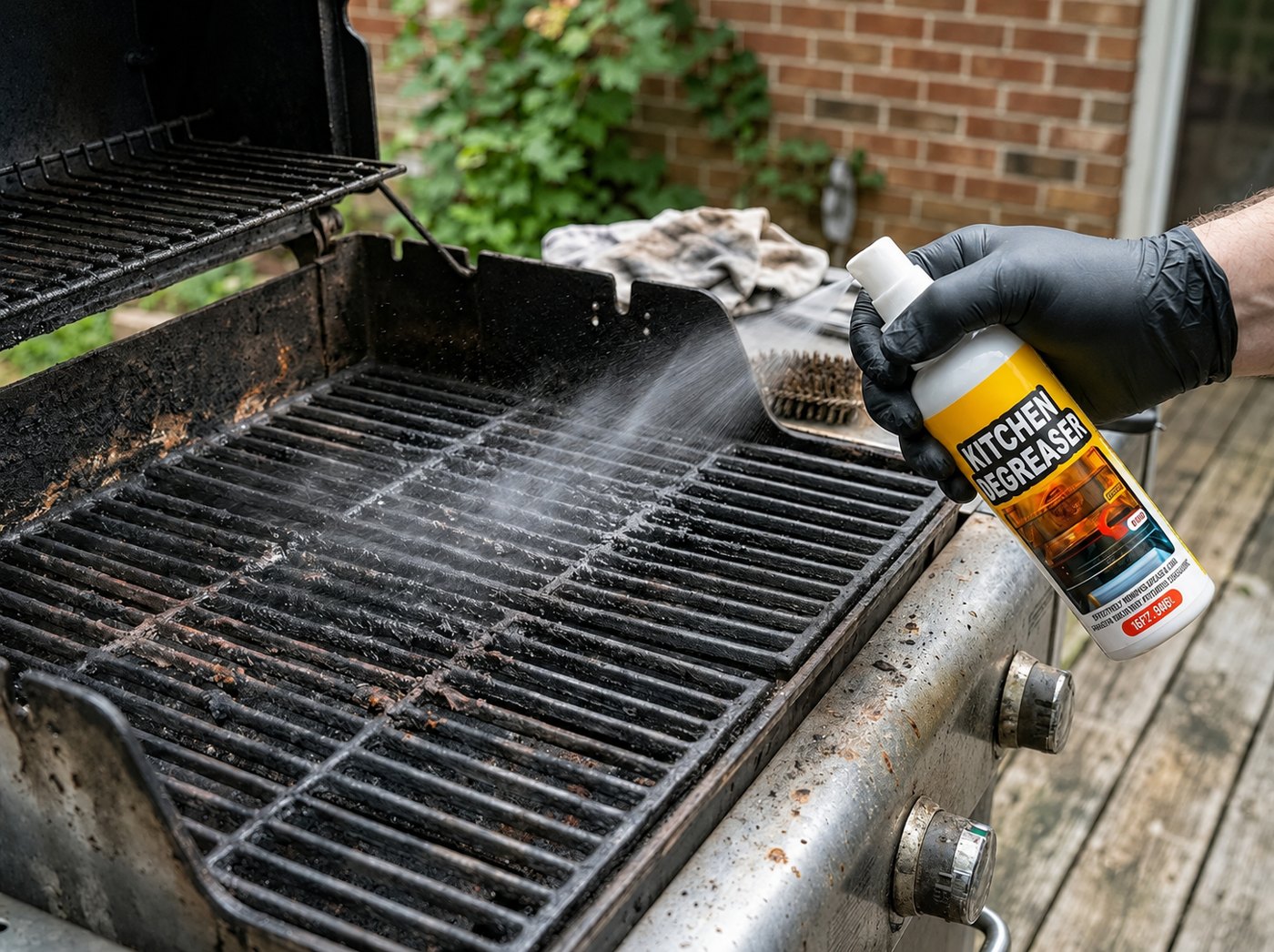
The verdict, up front
Pressure washing is genuinely good at clearing loose ash, drip trays and the outside of a grill cart — and it's fast. It is not a substitute for a chemical degreaser on the grates themselves, because polymerised grease is chemically bonded to the metal, not just sitting on top of it. Use both, in the right order, and you get a faster and safer clean than either method alone.
The physics of why blasting doesn't dissolve carbon
Polymerised grease forms when fat is repeatedly heated past its smoke point: the molecules cross-link and bond to the metal surface at close to a molecular level, similar to the process that creates cast-iron seasoning (which is exactly why pressure washing also strips seasoning). Water under pressure — even at 2,000–3,000 psi — applies mechanical force to whatever is sitting loosely on top of a surface. It has no chemical mechanism to break that cross-linked bond, so it removes ash and loose flakes very effectively while leaving the actual bonded layer mostly intact.
What you typically see afterward is a grate that looks wet and clean, then browns again within a day or two as the loosened surface film re-settles and the underlying bonded layer is exposed to oxygen and heat again. Meanwhile the pressure itself does real damage: porcelain enamel chips under direct high-pressure contact, cast iron seasoning strips off and the bare metal starts rusting within days of exposure to moisture, and water forced into burner tubes, venturi tubes or igniters causes ignition problems that outlast the cleaning session by weeks.
Time, cost and risk compared
Every method below removes grease eventually. The difference is how long it takes, what it costs per clean, and how much of your surface finish it takes with it.
| Method | Hands-on time | Cost per clean | Risk to finish |
|---|---|---|---|
| Pressure washing (grates) | 5–10 min | ~$0.05/clean (water) | High — chips enamel, strips seasoning, risks burners |
| Foaming grill cleaner (GreaseKiller) | 2 min dwell + 1 wipe | ~$1.30/clean | Low — safe on porcelain, stainless and cast iron |
| Wire brush scrubbing | 10–20 min hard scrub | ~$0.02/clean | Medium-high — scratches porcelain, sheds bristles |
| Self-clean burn-off (gas on high) | 15–20 min + scrape | ~$0.30/clean (gas) | Medium — hardens carbon further if not scraped promptly |
What pressure washing genuinely does well
- Clears ash, loose flakes and food debris from a firebox in seconds.
- Rinses drip trays and the underside of a grill lid quickly.
- Handles the cart, wheels and painted exterior without any chemistry at all.
- Covers large surfaces fast when the grease is fresh rather than carbonised — a grill wiped down weekly rarely needs anything stronger.
- Useful pre-rinse step to remove loose debris before applying a degreaser, cutting the degreaser's workload.
Where a chemical grill cleaner wins
- It attacks the chemical bond rather than just the loose surface layer, so carbon actually detaches and leaves with the wipe.
- No risk of chipping enamel or stripping cast iron seasoning through mechanical force.
- No water forced into burner tubes, igniters or the gas manifold.
- Usable on a balcony, patio or in a garage — no equipment, hose, electricity or runoff management needed.
- Two minutes of dwell and one wipe, versus hauling out and setting up a pressure washer for a single grate.
When pressure washing is honestly the better call
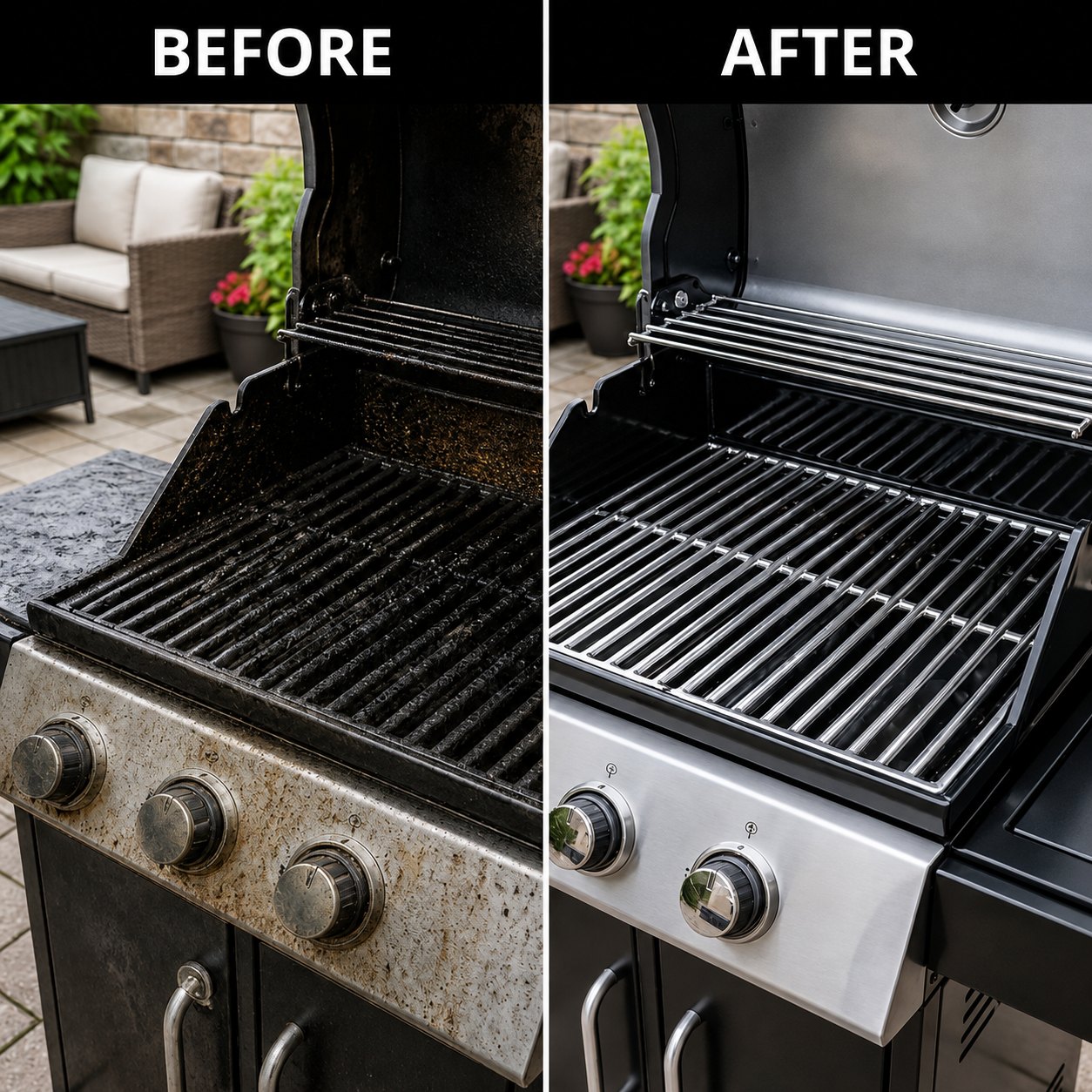
If you're cleaning the cart, wheels, exterior panels, or a firebox full of loose ash and light debris, a pressure washer (or even just a garden hose on a decent nozzle) beats spraying degreaser everywhere — it's faster, free, and there's no bonded carbon on those surfaces to dissolve in the first place. It's also the right tool for washing off a fresh, light grease film that hasn't had time to polymerise, such as after a single cookout, provided you keep the lance away from burners and control valves.
The combination that works best
- 1
Pressure wash the easy parts only
Firebox, cart, wheels, exterior and drip tray. Keep the lance away from burners, igniters and control valves entirely.
- 2
Let everything dry completely
Degreaser works on a dry surface. Standing water dilutes the foam and shortens its effective contact time on the grates.
- 3
Foam the grates and flame tamers
Even coat, two minutes of dwell, longer if the build-up is thick or hasn't been cleaned in months.
- 4
Wipe, rinse, dry and re-oil cast iron
One-directional wipe with a damp microfibre, clean-water rinse, then dry and lightly oil cast iron grates to rebuild the protective layer a pressure washer would have stripped.
Cost per clean, worked out
A gas or electric pressure washer costs $150–400 upfront plus water and electricity, and even after you own one, the grates still need a chemical follow-up for anything beyond loose debris — so the real cost of 'pressure washing your grill' properly is the machine plus a degreaser anyway. Renting one for occasional use runs $40–60 a day. GreaseKiller's 3-pack at $39 covers 36–45 full grate cleans, working out to roughly $1.00 per clean with zero equipment, water bill impact or setup time.
Mistakes that ruin the result
- Aiming a pressure washer directly at burner tubes, venturi tubes or igniters — this is the single most common cause of grills that won't light properly afterward.
- Pressure washing porcelain-coated grates at close range; the coating chips and then rusts from the exposed metal underneath.
- Skipping the re-oiling step on cast iron after any wet cleaning method, which leaves it to flash-rust within a day.
- Using a wire brush on porcelain grates to 'help' the degreaser along — it scratches the coating and creates rougher surfaces that grip grease faster next time.
- Applying degreaser to grates that are still hot from the last cook — wait until they're cool to the touch for full dwell time.
How we tested this
Everything below comes from bench runs on six residential gas grills with 2–8 months of built-up carbon on the grates rather than marketing copy. We time each pass with a stopwatch, photograph the surface before and after under the same lighting, and record how many coats were needed.
- Pressure washed one set of grates at 2,200 psi for 60 seconds, then photographed and dried before applying degreaser to compare residual carbon.
- Timed GreaseKiller's full cycle — spray, 2-minute dwell, wipe, rinse — with a stopwatch on matched grates.
- Inspected porcelain coating under raking light before and after pressure washing to check for chip marks.
- Weighed loosened carbon flakes collected from each method to compare actual material removed.
How many bottles do you actually need?
One bottle covers roughly 12–15 full cleans. Most people underbuy, run out mid-job and pay shipping twice — the multi-packs exist to avoid that, and the per-bottle price drops sharply as the pack grows.
| Your situation | Recommended pack | Price per bottle |
|---|---|---|
| One grill, cleaned after every few cookouts | 2-pack | $16.00 |
| Regular grillers — grates, flame tamers and hood | 3-pack | $13.00 |
| Multiple grills or a smoker plus a grill | 5-pack | $11.00 |
| Restaurant patio or commercial grill station | 8-pack | $9.00 |
Explore more
What customers say
“Rented a pressure washer thinking it'd save me the degreaser purchase. Grates looked clean for about a day, then went straight back to brown. Should've just started with GreaseKiller.”
Try GreaseKiller™ risk-free
Bundles start at $9 a bottle with free worldwide shipping and a 90-day results-or-refund guarantee. Checkout takes under a minute.
Get 50% Off Now