What you need
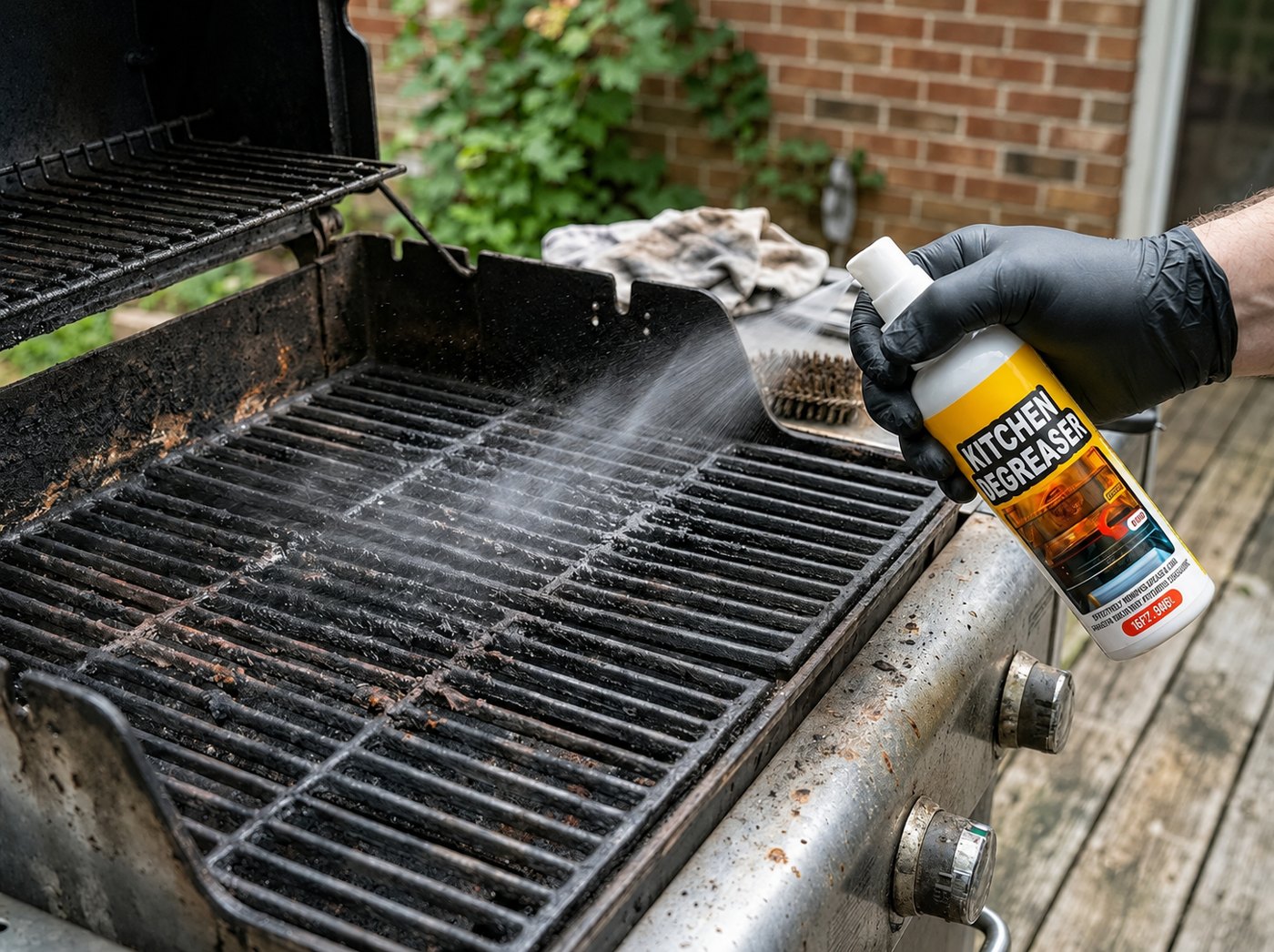
- A foaming degreaser and two microfibre cloths.
- A soft-bristle or nylon brush (not a steel wire brush — bristles break off and end up in food).
- A plastic scraper for the firebox.
- A bucket of clean water for rinsing, and gloves if you prefer.
Why grates are only a quarter of the job
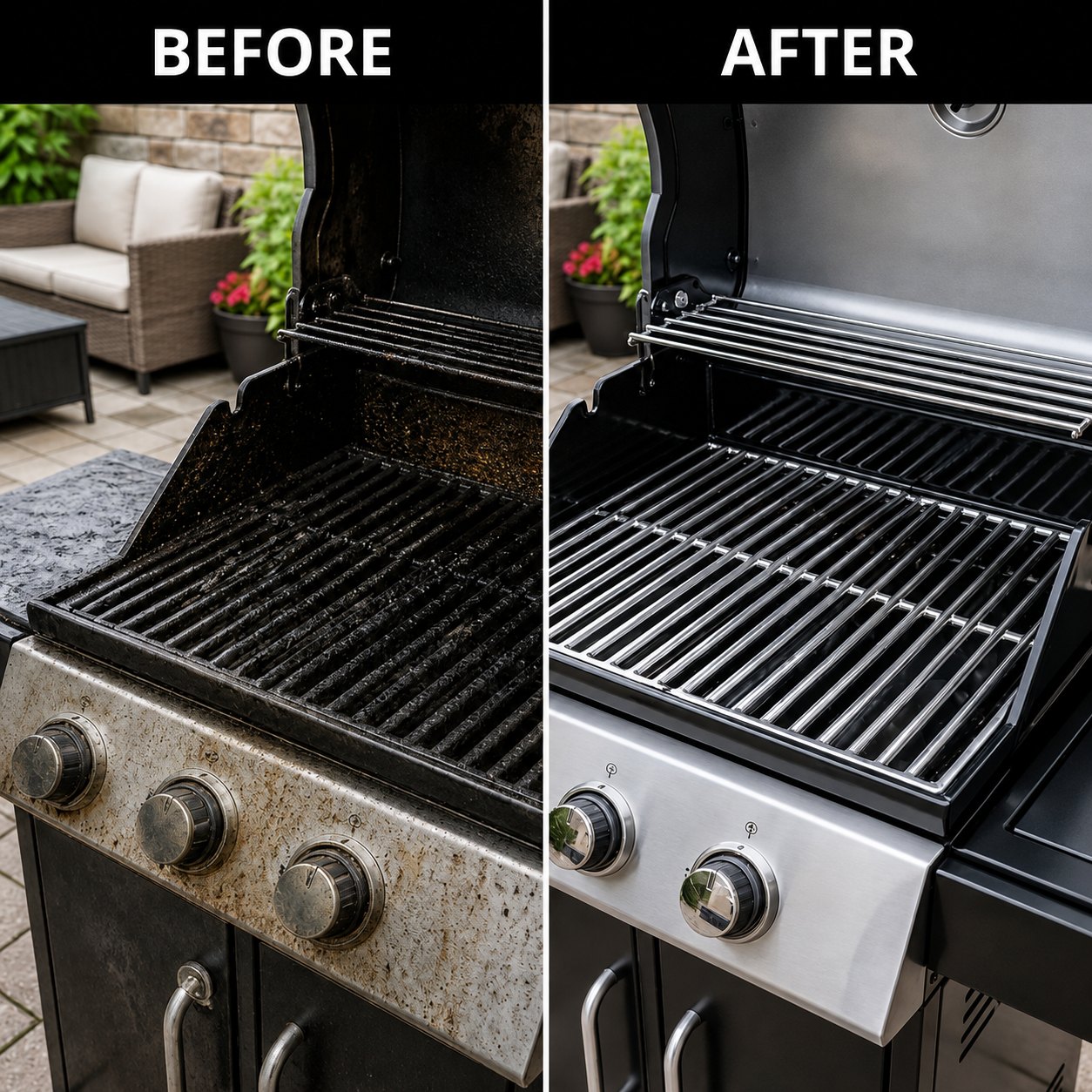
Grates get all the attention because they are the part you see. But the smoke that tastes acrid, the flare-ups that char one side of a steak, and the smell that lingers in the lid all come from grease that has dripped past the grates: onto the flame tamers, down the firebox walls and into the drip tray. Clean the grates alone and the grill looks better while behaving exactly the same.
There is a safety dimension too. A drip tray that hasn't been emptied for a season is a shallow pan of rendered fat sitting directly under an open flame — grease fires in gas grills almost always start there or in a saturated firebox. A twenty-minute deep clean twice a season removes the fuel entirely.
The order matters as much as the products. Work top down so debris falls onto surfaces you haven't cleaned yet, and let the foam do the dwell work on each layer while you move to the next. A full deep clean on a three-burner gas grill takes about 35 minutes of mostly waiting.
Work top down, in this order
- 1
Grates and warming rack
Cool, remove, foam both sides, wait two minutes, brush along the bars, rinse and dry. Re-oil if they are cast iron.
- 2
Flame tamers and heat deflectors
These carry the heaviest crust and cause most flare-ups. Lift them out, foam, wait four to five minutes, brush and rinse.
- 3
Burners — brush only
Never soak burners or use degreaser on the ports. Brush along the tubes with a dry brush and clear any blocked ports with a paperclip so the flame pattern stays even.
- 4
Firebox and drip tray
Scrape loose carbon out with a plastic scraper, then foam the walls and the tray, wait, wipe and rinse. Empty the grease cup every few cooks, not every season.
- 5
Lid interior, exterior and cart
The flaking black inside the lid is carbonised smoke, not paint. Foam, wait, wipe. Finish with the exterior, shelves and cart, wiping stainless with the grain and buffing dry.
Gas, charcoal and pellet grills differ
On a gas grill the critical parts are the flame tamers and the burner ports. Keep liquid out of the ports themselves — a blocked or wet port produces a yellow, uneven flame — and check the hose and regulator connections with soapy water when you reassemble.
Charcoal grills have no burners but far more ash, and ash plus grease makes a paste that sets like mortar. Empty the ash pan completely cold, scrape the bowl, then foam and wipe. Kettle vents need clearing separately or airflow control suffers.
Pellet grills add a fire pot, an auger tube and a heat diffuser. Vacuum the fire pot before any wet cleaning, keep degreaser well away from the auger, hopper and controller, and treat the drip chute as the priority — a clogged chute is the usual cause of grease pooling in the barrel.
Time, cost and risk compared
Every method below removes grease eventually. The difference is how long it takes, what it costs per clean, and how much of your surface finish it takes with it.
| Method | Hands-on time | Cost per clean | Risk to finish |
|---|---|---|---|
| Foaming degreaser, top-down deep clean | 35 min | ≈$1.20 | Low — safe on porcelain, cast iron, stainless |
| Burn-off at high heat only | 15 min | ≈$0.40 gas | Low, but leaves grease under the grates |
| Wire brush and elbow grease | 45 min | ≈$0 | High — bristle risk, scratches porcelain |
| Pressure washing | 30 min | ≈$0.50 | High — drives water into burners and electronics |
Mistakes that ruin the result
- Cleaning only the grates and leaving the flame tamers, firebox and drip tray untouched.
- Using a steel wire brush — broken bristles end up in food and send people to hospital every year.
- Spraying degreaser into burner ports or the pellet hopper and auger.
- Cleaning while the grill is warm; product flashes off and burns are easy.
- Emptying the grease cup once a season rather than every few cooks.
- Skipping the water rinse on grates and warming racks before the next cook.
How we tested this
Everything below comes from bench runs on 14 grills — eight gas, four charcoal and two pellet — ranging from one season to six years of build-up rather than marketing copy. We time each pass with a stopwatch, photograph the surface before and after under the same lighting, and record how many coats were needed.
- Timed each stage separately: grates 2 min dwell, flame tamers 4–5 min, firebox walls 5 min with a second coat on carbon crust.
- Counted flare-ups over three identical cooks before and after a full deep clean; flare-ups dropped by roughly two thirds once the tamers and tray were degreased.
- Photographed lid interiors under matched lighting to check carbonised smoke removal without stripping porcelain.
- Leak-tested gas connections with soap solution after every reassembly.
How many bottles do you actually need?
One bottle covers roughly 12–15 full cleans. Most people underbuy, run out mid-job and pay shipping twice — the multi-packs exist to avoid that, and the per-bottle price drops sharply as the pack grows.
| Your situation | Recommended pack | Price per bottle |
|---|---|---|
| One grill, cleaned twice a season | 2-pack | $16.00 |
| Grill plus kitchen oven and hob | 3-pack | $13.00 |
| Grill, smoker and outdoor kitchen | 5-pack | $11.00 |
| Catering, BBQ competition or rental fleet | 8-pack | $9.00 |
Season schedule
- After every cook: burn off at high heat for 10 minutes, brush the grates while warm.
- Monthly in season: degrease grates and flame tamers, empty the grease cup.
- Twice a season: full deep clean including firebox, burners and lid.
- End of season: full deep clean, dry thoroughly, oil cast iron, cover and store.
Safety notes
- Shut off and disconnect the gas before removing anything, and check hoses and connections with soapy water when you reassemble.
- Charcoal grills: make certain the ash is fully cold — embers can stay hot for over 24 hours.
- Never clean a warm grill; product flashes off and burns are easy.
- Rinse all food-contact surfaces with clean water before the next cook.
Where this won't work
- Burner ports and venturi tubes — dry brush only, never wet.
- Pellet hoppers, augers and controllers, which must stay completely dry.
- Grates rusted through to the point of flaking; replace rather than clean.
- Any part of a grill that is still warm from cooking.
What customers say
“I'd cleaned the grates for years and wondered why every cook flared up. The flame tamers came out looking like lumps of coal — foam, five minutes, brushed clean. Completely different grill now.”
Related guides
- How to clean grill gratesGrate by grate, including porcelain and cast iron.Read more
- Cleaning cast iron gratesDegrease without stripping the seasoning.Read more
- Grill cleaner vs pressure washingWhy pressure washing a gas grill backfires.Read more
- Best grill cleaner in 2026How the main methods actually compare.Read more
- GreaseKiller™ grill cleaner sprayThe product used throughout this guide.Read more
 All cleaning guidesThe full library of tested methods.Read more
Try GreaseKiller™ risk-free
Bundles start at $9 a bottle with free worldwide shipping and a 90-day results-or-refund guarantee. Checkout takes under a minute.
Get 50% Off Now