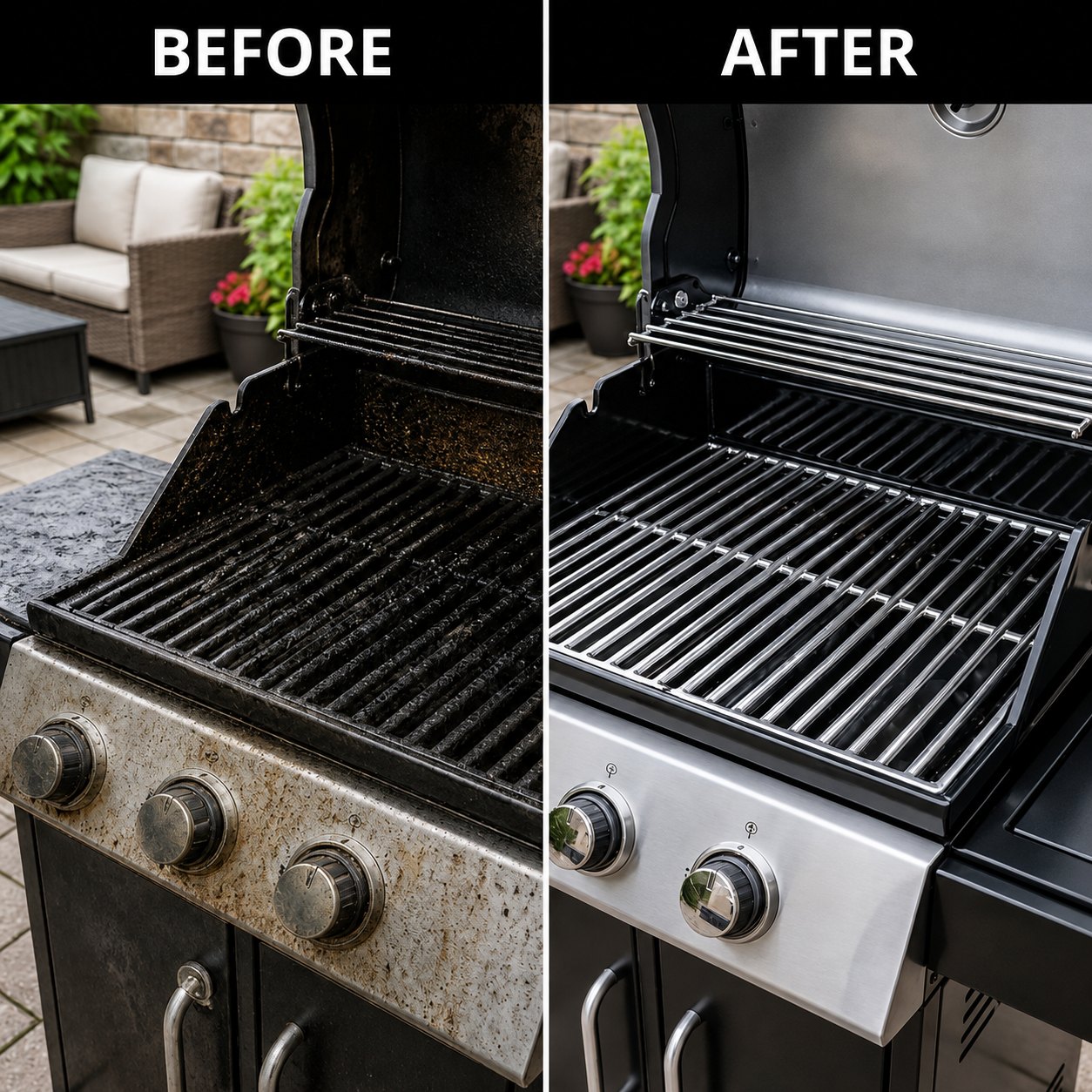
Why scrubbing doesn't work
When fat is heated past its smoke point over and over, its molecules cross-link into a tough, varnish-like polymer. That layer is bonded to the surface, not resting on it, so abrasion has to grind away the metal's finish to reach underneath.
That is why an hour with a scourer leaves you with a scratched, dull surface that still has brown patches. The bond has to be broken chemically first; after that, removal takes one wipe.
This matters more than it sounds. Once a finish is scratched, grease finds it easier to re-bond into the abraded surface next time, so a bad scrubbing session today makes next month's clean worse, not better. Chemical loosening leaves the finish intact, which is why the same panel gets progressively easier to clean over successive cleans rather than progressively harder.
What actually dissolves it
Two things are doing the work: a solvent system that softens the cross-linked polymer, and a surfactant that lifts it off the surface once it's soft. Alkalinity speeds both processes up, which is why most effective degreasers — including foaming sprays — sit on the alkaline side of neutral rather than being acidic like vinegar or citrus cleaners.
Heat and time both help the chemistry, but you rarely have heat available safely (spraying a hot surface is dangerous and wastes product), so dwell time is the lever you actually control. Two minutes is enough for most household build-up; longer dwell only helps if the layer is genuinely thick.
The four-step method
- 1
Let the surface cool completely
Never spray a hot surface. Wait until the surface is cool to the touch, then brush or wipe away loose crumbs, ash and food debris so the foam reaches the grease itself.
- 2
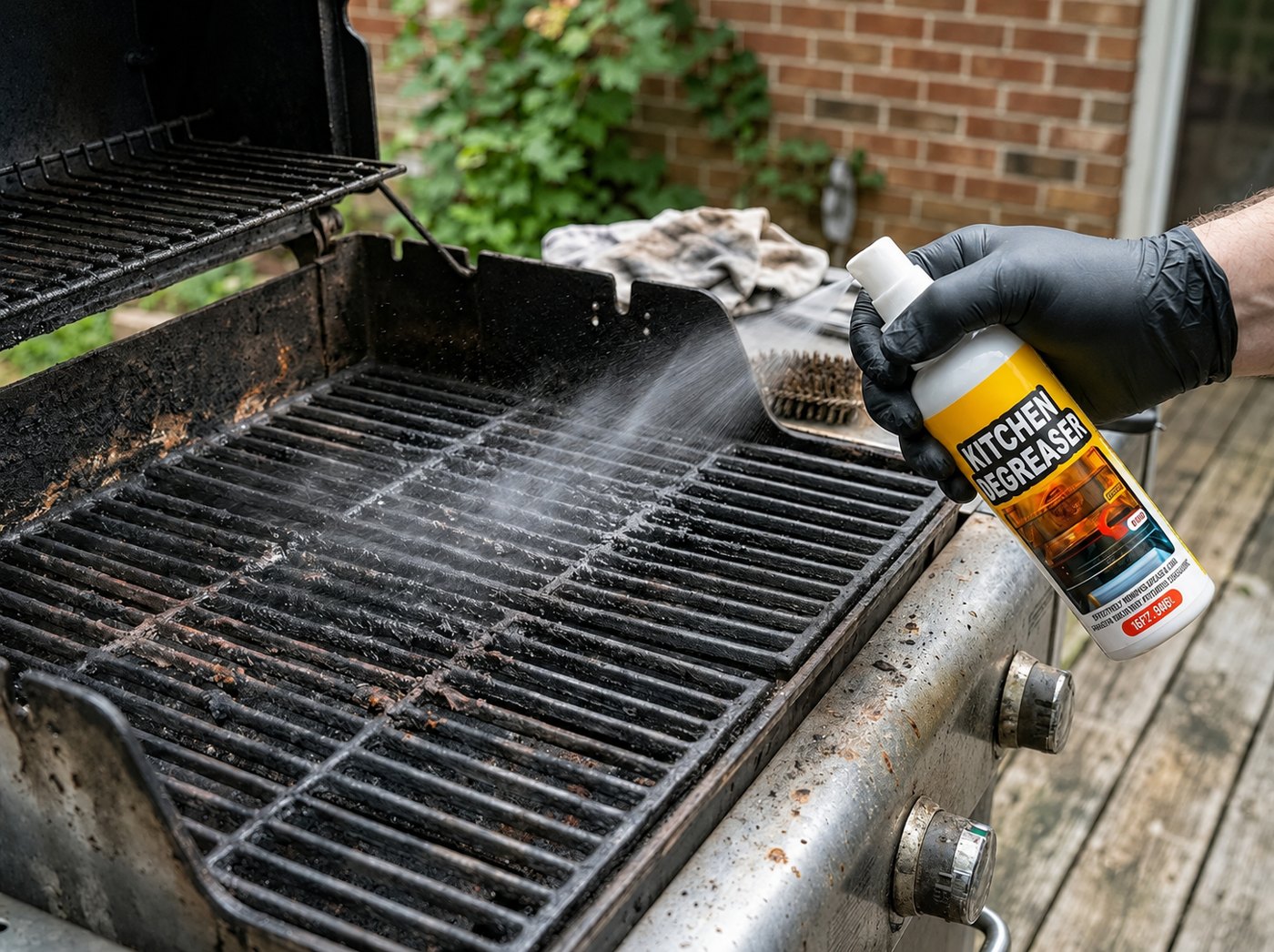
Spray an even coat of foam
Hold the bottle 4–6 inches away and lay down a thin, even layer. The foam is designed to cling to vertical surfaces, so you don't need to soak anything.
- 3
Wait about two minutes
This is where the work happens. The formula penetrates the carbonised layer and breaks its bond with the metal. Very heavy build-up may want 4–5 minutes or a second coat.
- 4
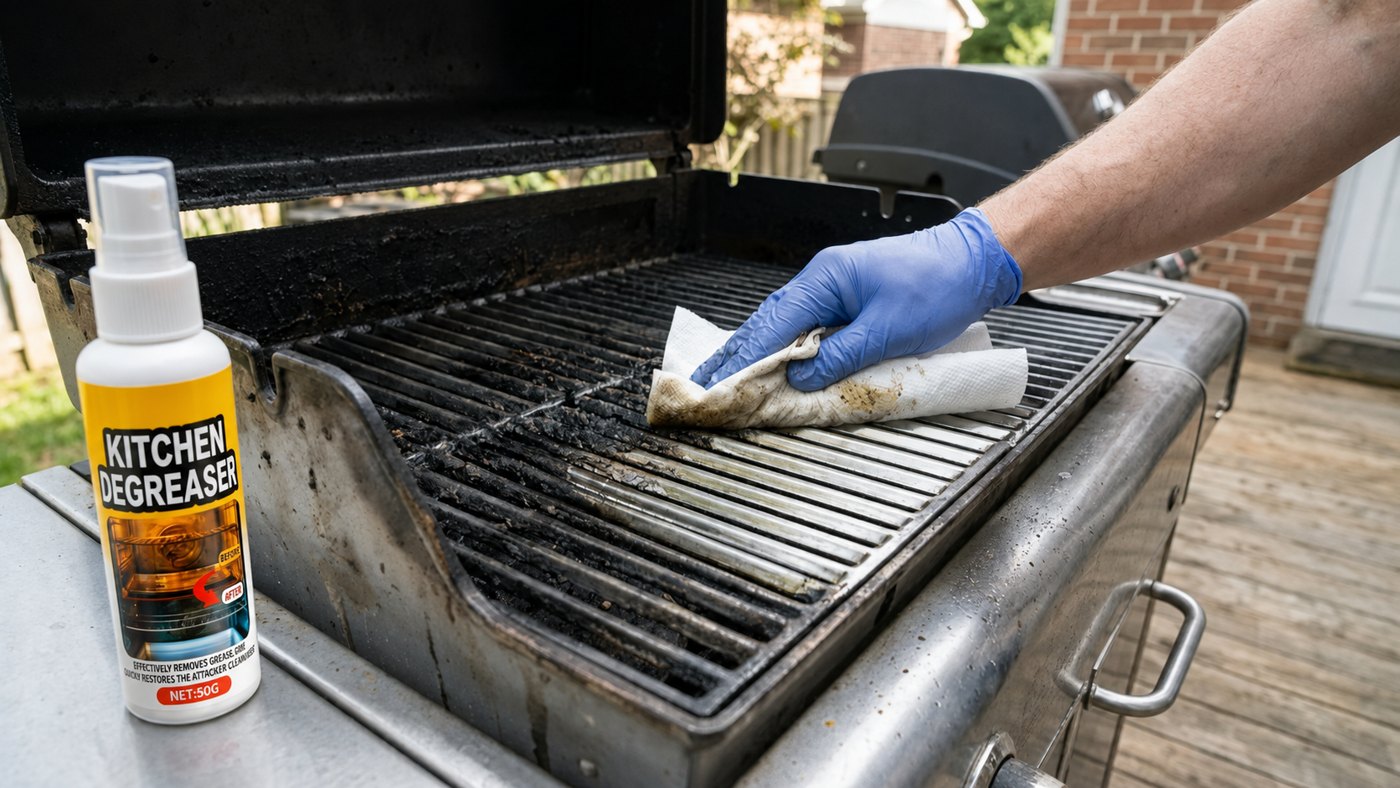
Wipe, rinse and dry
Wipe in one direction with a damp microfibre cloth. Use a soft brush on textured cast iron. Rinse any surface that will touch food, then dry to prevent water spots.
Adjusting for how bad it is
- Light film from recent cooking: two minutes, single coat, wipe.
- Visible brown build-up: four to five minutes, single coat.
- Thick black carbon: coat, wait five minutes, wipe off what releases, then repeat on what's left.
- Years of neglect: expect two or three passes. Each pass takes a layer; do not try to force one pass with a scourer.
- Corners and rivets: dwell time matters more than pressure here — a soft toothbrush after the foam has worked reaches into seams that a cloth can't.
Surface-by-surface notes
- Stainless steel: wipe with the grain, then dry to avoid streaks.
- Cast iron: soft brush rather than a cloth, then dry and re-oil to protect the seasoning.
- Porcelain enamel and glass: no abrasives at all — let dwell time do the work.
- Aluminium: avoid alkaline degreasers, which discolour it. Mild soap and patience instead.
- Painted or lacquered finishes: test a hidden spot first.
Time, cost and risk compared
Every method below removes grease eventually. The difference is how long it takes, what it costs per clean, and how much of your surface finish it takes with it.
| Method | Hands-on time | Cost per clean | Risk to finish |
|---|---|---|---|
| Foaming degreaser + dwell | 5–8 min | ≈$1.50 | Low — no abrasion |
| Steel wool / scourer | 30–60 min | ≈$0.50 | High — strips finish |
| Oven cleaner (caustic) | 20–40 min + venting | ≈$1.00 | Medium — fumes, discolours aluminium |
| Baking soda paste | 15–25 min | ≈$0.20 | Low but weak on heavy carbon |
| Pressure washer | 10–15 min | ≈$0.10 (water) | Medium — can drive grease into seams |
Mistakes that ruin the result
- Spraying a hot surface — the product flashes off before it can act, and it's unsafe.
- Wiping too early. Two minutes of waiting saves ten minutes of scrubbing.
- Using a steel scourer on coated surfaces, which permanently ruins the finish.
- Mixing cleaners. Never combine anything with bleach.
- Skipping the rinse on food-contact surfaces.
- Assuming one coat will fix years of neglect — it won't, and forcing it just scratches the surface.
How we tested this
Everything below comes from bench runs on grill grates, oven trays, stovetops and range hood filters rather than marketing copy. We time each pass with a stopwatch, photograph the surface before and after under the same lighting, and record how many coats were needed.
- Tested on 20+ surfaces with visible carbonised build-up ranging from one week to several years old.
- Each surface photographed before and after under identical lighting to judge single-pass vs multi-pass results.
- Dwell times timed with a stopwatch: 2, 4 and 5-minute intervals compared on matched grease loads.
- Wipe force kept consistent (light hand pressure, microfibre cloth) to isolate the chemistry from the scrubbing.
How many bottles do you actually need?
One bottle covers roughly 12–15 full cleans. Most people underbuy, run out mid-job and pay shipping twice — the multi-packs exist to avoid that, and the per-bottle price drops sharply as the pack grows.
| Your situation | Recommended pack | Price per bottle |
|---|---|---|
| One kitchen, occasional cook | 2-pack | $16.00 |
| Household with a grill + oven | 3-pack | $13.00 |
| Heavy use / multiple appliances | 5-pack | $11.00 |
| Multi-household or gifting | 8-pack | $9.00 |
Where this won't work
- Unfinished or bare aluminium — alkaline formulas can discolour it; use mild soap instead.
- Unsealed natural stone such as marble or granite worktops.
- Any surface that is still hot — always let it cool first.
- Fabric, upholstery or carpet.
- Catalytic or self-cleaning oven liners, which are designed not to be treated with external cleaners.
What customers say
“I'd spent an entire Saturday with a wire brush on my grill grates and barely made a dent. This took two coats and about ten minutes total, and the grates came out cleaner than when I bought them.”
Explore more guides
 All cleaning guidesThe full library of tested methods for grease problems.Read more
- How to clean a BBQ grillThe full top-to-bottom deep-clean checklist.Read more
- Clean your oven without scrubbingDoor glass, racks and oven floor made easy.Read more
- Baking soda vs degreaserWhere the paste helps, and where it doesn't.Read more
Try GreaseKiller™ risk-free
Bundles start at $9 a bottle with free worldwide shipping and a 90-day results-or-refund guarantee. Checkout takes under a minute.
Get 50% Off Now