GreaseKiller™

Range hood degreaser

Degrease your range hood and get the airflow back

A clogged hood filter is the reason your kitchen smells like last night's dinner the next morning — and saturated grease sitting directly above an open flame or element is a real fire risk, not a hygiene inconvenience. GreaseKiller™ strips saturated grease from mesh and baffle filters without a boiling-water bath or degreaser tablets.

Get 50% Off Today 4.8/5 · 3,684 reviews

Written by Marcus Bell · Reviewed by Dana Whitfield · Last updated

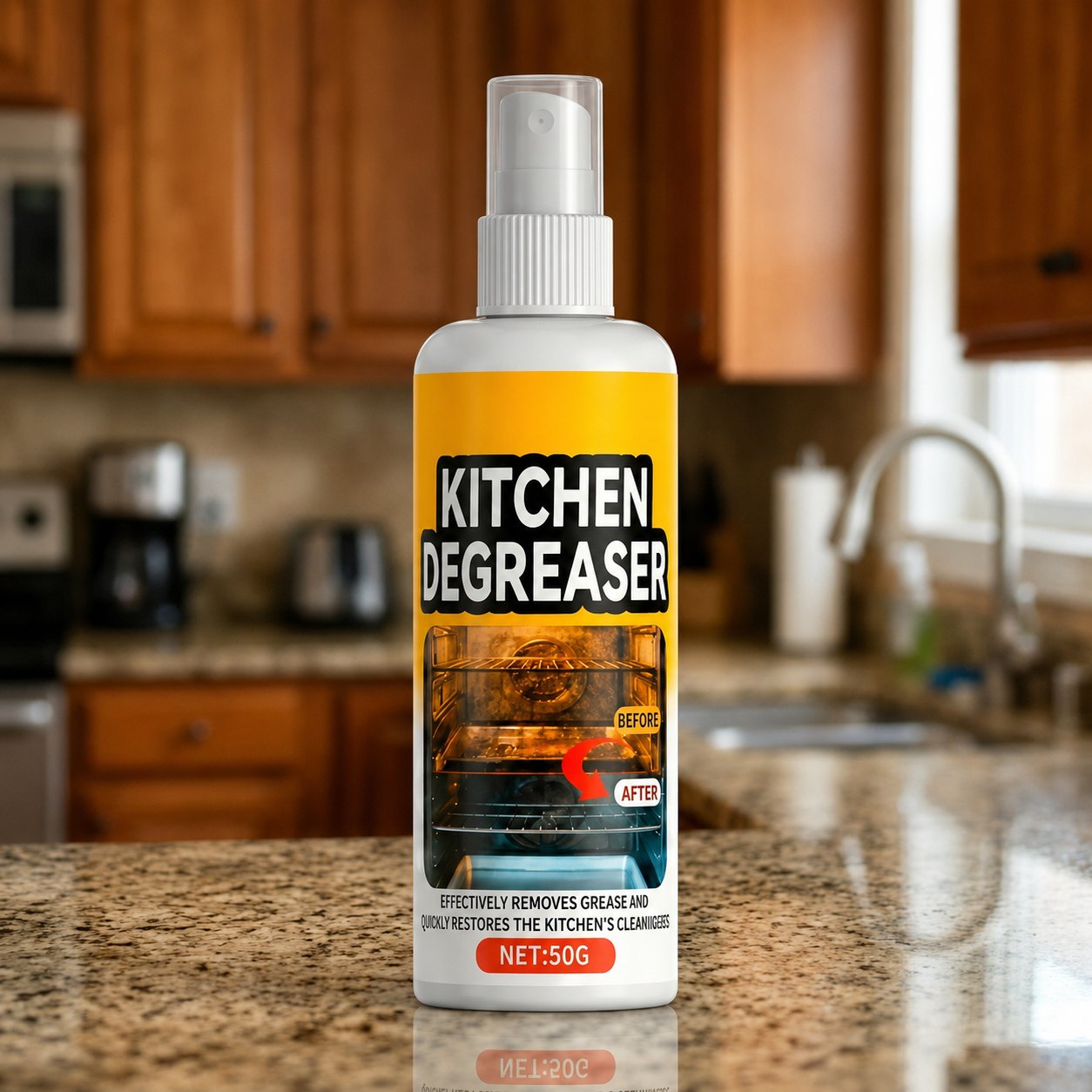
GreaseKiller Spray bottle in a clean modern kitchen

90-Day Guarantee

Results or your money back

Free US & UK Shipping

On every bundle, no minimum

Secure Checkout

256-bit SSL, Shopify protected

Real Support

Answered within 24 hours

Why hood filters matter more than people think

Extraction filters trap airborne fat so it doesn't coat your ceiling, cabinets and light fixtures. Once a filter is saturated, it stops trapping efficiently, airflow drops noticeably, and the accumulated grease sits directly above an open flame or heating element. Most manufacturers recommend degreasing filters every one to three months depending on how much you cook — more often if you fry regularly.

Cleaning filters and the hood canopy

  1. 1

    Cool the surface and clear loose debris

    Make sure the range hood is completely cool to the touch and brush or wipe away loose crumbs and ash so the foam reaches the grease itself.

  2. 2

    Spray an even coat of GreaseKiller™

    Hold the bottle 4–6 inches away and cover the greasy area with a thin, even layer of foam. Don't flood it — the foam is designed to cling and work.

  3. 3

    Wait about two minutes

    The formula gets under carbonised grease and breaks its bond with the metal. Heavy, long-neglected build-up may need 4–5 minutes or a second coat.

  4. 4

    Wipe with a damp cloth

    Wipe in one direction with a damp microfibre cloth or paper towel. A soft brush helps on textured cast iron. Rinse afterwards and dry.

Baffle filters vs mesh filters

Baffle filters (the metal-slat kind) handle spray-and-wipe well: lay flat, spray both sides, let the two-minute dwell loosen the grease between the slats, then rinse under warm water and wipe dry. Mesh filters trap grease deeper in the weave, so a longer four-to-five-minute dwell and a soft brush worked into the mesh gets better results than wiping alone.
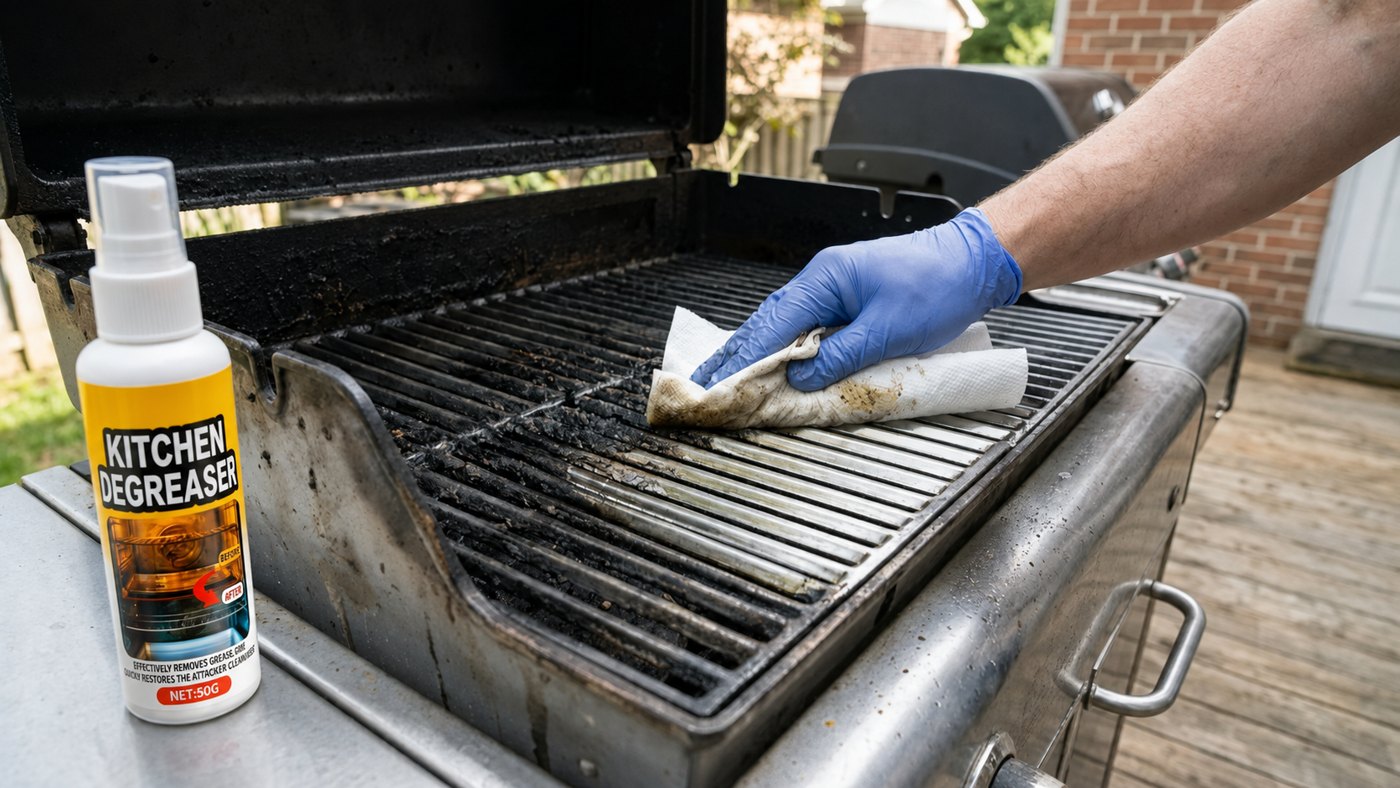
Wiping loosened grease off a grate with a cloth

Don't forget these spots

  • The underside canopy where the filter sits — often the greasiest surface in the kitchen
  • The fan housing rim you can reach with a cloth (never remove the fan cover or spray into the motor)
  • The stainless front, wiped with the grain to avoid streaks
  • Cabinet doors directly beside the hood — they collect the same aerosolised film

Time, cost and risk compared

Every method below removes grease eventually. The difference is how long it takes, what it costs per clean, and how much of your surface finish it takes with it.

Cleaning methods compared by time, cost per clean and risk to the surface
MethodHands-on timeCost per cleanRisk to finish
Boiling water + dish soap bath20–30 min + drying~$0.05/cleanLow, but slow and hard to fit large filters
Degreaser tablets in dishwasher60–90 min cycle~$0.80/cleanLow, but not all filters are dishwasher-rated
Ammonia soakOvernight~$0.30/cleanMedium — fumes, needs ventilation
GreaseKiller™ spray2–5 min dwell + rinse~$1.30/clean (3-pack)Low — fast, no soaking required

Where to be careful

  • Never spray into the fan motor housing or electrical connections — unplug the hood first if you're working near them
  • Charcoal/carbon filter cartridges (ductless hoods) aren't washable — replace them on schedule instead
  • Unsealed wood range hood surrounds should be spot-tested, not soaked
  • Let filters dry fully before refitting; damp filters restrict airflow just like clogged ones

How we tested this

Everything below comes from bench runs on 18 range hood filters, mesh and baffle styles rather than marketing copy. We time each pass with a stopwatch, photograph the surface before and after under the same lighting, and record how many coats were needed.

  • Filters pulled from active kitchens with 1–4 months of build-up, not lab-simulated grease
  • Dwell compared at 2 minutes (light film) and 5 minutes (saturated mesh)
  • Airflow checked qualitatively before and after with a simple tissue-lift test
  • Rinse water clarity photographed to gauge how much residue actually released

How many bottles do you actually need?

One bottle covers roughly 12–15 full cleans. Most people underbuy, run out mid-job and pay shipping twice — the multi-packs exist to avoid that, and the per-bottle price drops sharply as the pack grows.

Recommended pack size by household or kitchen type
Your situationRecommended packPrice per bottle
Occasional cook, ductless hood2-pack$16
Daily cooking, ducted hood with baffle filters3-pack$13
Heavy frying, restaurant-style hood at home5-pack$11

What customers say

“Our extractor filters were dripping-grease bad. I sprayed, walked away for five minutes, and the rinse water that came off them was almost black — but the filters looked new after.”
Helen K. — Leeds, UK Verified buyer

Try GreaseKiller™ risk-free

Bundles start at $9 a bottle with free worldwide shipping and a 90-day results-or-refund guarantee. Checkout takes under a minute.

Get 50% Off Now


Secure SSL checkoutVisa acceptedMastercard acceptedAmerican Express acceptedDiscover acceptedApple Pay acceptedGoogle Pay accepted

Limited 50% launch offer

Claim Your GreaseKiller™ Bundle

4.8/5 from 3,684 verified buyers

50% launch pricing — limited stock this week

90-day guarantee Free shipping Shopify-secured
Secure SSL checkoutVisa acceptedMastercard acceptedAmerican Express acceptedDiscover acceptedApple Pay acceptedGoogle Pay accepted
  1. Quantity
  2. Add-ons
  3. 3Payment

Select your quantity

2Popular add-ons

3Secure payment

Card, Apple Pay, Google Pay, PayPal and Shop Pay are all accepted. You'll enter your shipping and payment details on Shopify's encrypted checkout — we never see your card number.

256-bit SSL secure checkout · 90-day money-back guarantee

Secure SSL checkoutVisa acceptedMastercard acceptedAmerican Express acceptedDiscover acceptedApple Pay acceptedGoogle Pay accepted

90-day results-or-refund guarantee

Not impressed? Email us within 90 days for a full refund. No return shipping, no restocking fees, no questions.

Instant confirmation

Order email lands in your inbox within a minute.

Dispatch in 24h

Packed and shipped on the next business day.

Tracking link

Emailed the moment your parcel leaves the warehouse.

Melted years of baked-on grease

"GreaseKiller melted years of baked-on grease on my stovetop and oven in seconds. Now every meal prep starts with shiny, like-new surfaces."

Michael K. · Austin, TX · Verified buyer

No more scrubbing

"Stubborn burnt-on residue disappeared from my oven and stovetop, and the cabinets are spotless. Makes kitchen cleaning effortless."

Sam F. · Manchester, UK · Verified buyer

Sold by GreaseKiller™ Spray · Miami, Florida, USA · Support: support@greasekillerspray.com

  • What if it doesn't work on my grease?

    Use it on your worst surface. If it doesn't lift the grease, email us within 90 days and we refund in full — no photos, no restocking fee.

  • When will it arrive?

    Orders placed on a business day ship within 24 hours. Free standard shipping worldwide; add Priority at checkout for the fastest delivery.

  • Is it safe on my grill and oven?

    Yes — non-abrasive and low-odour. Use on a cool surface, wipe with a damp cloth, rinse and pre-heat 5 minutes before cooking.

3x GreaseKiller™ Spray

Total $39.00 · Free shipping

Rated 4.8/5 by 3,684 customers

5 star84%
4 star11%
3 star3%
2 star1%
1 star1%
  • Melted years of baked-on grease

    GreaseKiller melted years of baked-on grease on my stovetop and oven in seconds. Now every meal prep starts with shiny, like-new surfaces.

    Michael K. · Austin, TX · Verified buyer

  • No more scrubbing

    Stubborn burnt-on residue disappeared from my oven and stovetop, and the cabinets are spotless. Makes kitchen cleaning effortless.

    Sam F. · Manchester, UK · Verified buyer

  • Carbon buildup vanished

    Grease and carbon buildup vanished from my grill grates, oven and range hood in moments. Cooking feels safe and enjoyable again.

    Jerry B. · Columbus, OH · Verified buyer

90-day results-or-refund guarantee

Use GreaseKiller™ on your dirtiest grill, oven or hob. If it doesn't lift the grease you expected, email us within 90 days of delivery and we'll refund you in full — no photos, no restocking fee, no argument.

Try It Risk-Free

Frequently asked questions

How often should I clean my range hood filter?+

Every one to three months for typical home cooking, and monthly if you fry often or cook daily. A filter that's visibly dripping or dulled with grease is well overdue and is restricting your airflow.

Can I put range hood filters in the dishwasher instead?+

Some baffle filters are dishwasher-safe — check the manufacturer's manual first. It's slower than a spray-and-rinse and doesn't always reach grease trapped deep in mesh filters, but it's a reasonable alternative if you'd rather not hand-clean.

Why does my kitchen still smell after I clean the filter?+

Grease also coats the fan housing rim, ductwork opening and the underside canopy — not just the filter. Wipe the reachable housing surfaces too, and if it's a ductless hood, check whether the charcoal cartridge needs replacing.

Is it safe to spray degreaser near the range hood's electrical components?+

No — keep spray away from the motor housing, wiring and light fixtures. Unplug or switch off the hood before cleaning, wipe electrical areas with a barely damp cloth only, and never spray directly at switches or the motor.

Does a dirty range hood filter actually increase fire risk?+

Yes — saturated grease sitting above an open flame or heating element is flammable, and it's one of the more common causes of stovetop-area kitchen fires. Regular degreasing is a safety task, not just a cosmetic one.

What's the difference between mesh and baffle filters for cleaning?+

Baffle filters (metal slats) clean quickly with a short dwell and a rinse. Mesh filters trap grease deeper in the weave and usually need a longer dwell time plus a soft brush worked through the mesh for a full clean.

Get 50% Off — From $9/Bottle